

Meta published an update to its commercial terms seeking broad permission to collect content from businesses’ websites. An early version also mentioned using the content to train Meta’s products. Publishers objected, Meta removed the reference to training, but the dispute did not end.
Norwegian media companies took legal action. In Finland, Kaleva Media announced that it would stop using Facebook and Instagram if the terms took effect as proposed. For opponents, the issue was whether Meta could make access to its services conditional on the right to use content produced at others’ expense.
What did the terms actually say, what was removed and why was the change not enough to settle the criticism?
Note: Revla is a marketing agency and does not provide legal advice. This article discusses the topic in general terms and does not replace a company-specific legal assessment. There is conflicting information about the update’s timetable, which we discuss below. This article does not establish that the change has already taken effect.
Meta wanted the right to use web content to train AI
Meta was updating its commercial terms of use. In the version archived on 16 October, it sought permission to collect content from websites associated with businesses and also use that material to train its products. An article or image behind a link a business shared on Facebook could therefore be part of this material. It was the possibility of using website content to train AI that prompted opposition, particularly from publishers.
This was not just about the link title and thumbnail displayed on Facebook, but also material on the business’s own website. The permission sought went beyond individual link shares: it would cover pages relating to products or services, as well as URLs that became available through the business’s or other users’ use of Meta services.
The English text listed developing, researching and training products, services and features among the uses of the content. It explicitly included the word train.
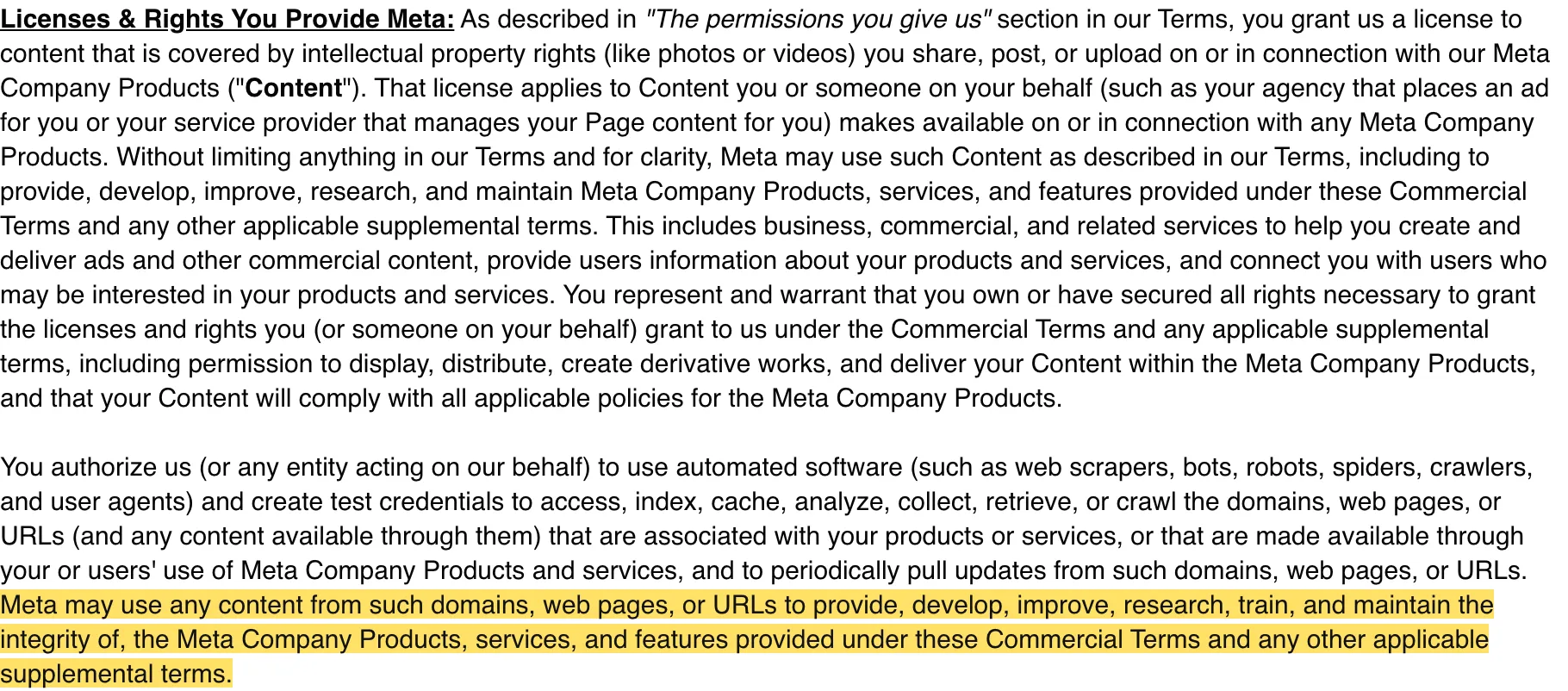
Screenshot of the version of Meta’s terms page archived on 16 October 2026. We have highlighted the sentence mentioning training in yellow; the wording of the terms has not been altered.
This was a proposed permission to use content, not evidence that any particular business’s content had already been used as training material. The text also did not specify which AI models the training would concern.
Publishers opposed granting rights as a condition of using the service
The US-based News/Media Alliance criticised the proposal on 16 October. According to the organisation, Meta could obtain content from websites associated with businesses to train its AI products, and commercial users would have no separate option to reject the terms while continuing to use the services.
There was a clear business question behind the publishers’ objection. A newsroom pays journalists and photographers to produce content. If a platform could take that material to develop its own competing services without a separate licensing agreement or compensation, the content producer’s ability to decide how its work is used and earn revenue from it would be weakened.
At the same time, leaving the platforms could mean losing an important audience. Publishers therefore did not see the choice as simply an ordinary voluntary agreement: accept broad usage rights or give up a channel through which you reach your readers.
This is the argument made by publishers and the organisations representing them. It does not in itself settle the legality of the terms, but it explains why they saw this as a much bigger issue than a single social media post.
Meta removed the reference to training and denied that the update was about collecting news website content
In the archive capture from the following day, 17 October 2026, the sentence mentioning training was gone. Instead, the collection of web content was linked to providing, developing, improving, researching and maintaining advertising and business products, as well as the safety of Meta products.
Meta had therefore changed the very wording that had raised concerns about AI training. Permission to collect web content and use it to develop advertising and business products nevertheless remained. The scope of that permission continued to be disputed.
Meta also rejected critics’ interpretation of the update’s purpose. In a response published by The Verge on 22 October, company spokesperson Daniel Roberts said that the update was not about collecting content from news websites. According to him, content owners could still express their preferences about collection through their website’s robots.txt file, and the updates would not grant new rights to override those preferences.
Robots.txt is an instruction file on a website that tells automated programs, or crawlers, what they may fetch. The file does not block access to content, and its existence does not guarantee that programs will follow its instructions. A program can technically ignore them altogether. That is why publishers also cared about what Meta would commit to in the contractual terms themselves.
Why was the new wording not enough for critics?
Removing the word referring to training did not eliminate all the questions about what the material could be used for or how broadly it could be collected. The criticism focused on three issues in particular.
Developing business products could still include AI training
Media and intellectual property lawyer Matt Topic argued that develop was broad enough to cover training as well. The Verge reported on his interview with Nieman Lab: in his view, if Meta develops AI-based business products, removing the reference to training does not necessarily exclude training.
This is a legal interpretation attributed to a named expert, not a definitive ruling on everything the clause would permit. It nevertheless shows why removing a single word did not meet critics’ demand for a clear limit on usage.
Permission would not be limited to articles shared by the business itself
The Verge also reported on Cornell law professor James Grimmelmann’s assessment given to Nieman Lab. He drew attention to the broad wording about websites relating to products or services. His concern was that the revision did not sufficiently narrow how much of a website Meta could collect.
From a publisher’s perspective, the distinction matters: it might choose to share one article on Facebook without also wanting to grant broad permission to use the content of its entire publication.
Publishers wanted public assurances written into the contract too
The global news publishers’ organisation WAN-IFRA called on 22 October for the commitment concerning websites’ machine-readable collection instructions to be written into the terms. The organisation also called for separate licensing for AI use of content and the ability to refuse collection without losing access to Meta’s business tools.
The issue was therefore not just whether publishers believed Meta’s spokesperson. They wanted the restrictions to appear in the contract they were expected to accept.
Kaleva raised the prospect of leaving, while Norwegian companies took legal action
In Finland, Kaleva Media made its position clear. CEO Juha Laakkonen said in Suomen Lehdistö’s newsletter on 29 October:
“If Meta’s terms take effect as proposed, Kaleva Media will stop using Facebook and Instagram.”
(Our translation.)
Laakkonen described this as a choice based on values: journalistic content is worth more to the company than any single distribution channel. The announcement was conditional. It does not mean that Kaleva had already left the platforms.
In Norway, opposition led to legal action. NRK reported on 27 October, in a story updated on 28 October, that companies including NRK, TV 2, Schibsted and Amedia had asked a court in Oslo to halt the new terms until their legality had been assessed.
NRK’s report concerns these companies’ legal action, not their departure from Meta’s platforms. NRK’s legal director Olav Nyhus also explained that leaving the platforms was not straightforward because the company needed to reach its audience.
A willingness to leave and legal action show that the opposition went beyond disapproving comments. They also illustrate businesses’ different positions: one is prepared to give up a channel, while another considers it so important for reaching its audience that it must challenge the terms in another way.
Implementation was postponed, but that does not mean the proposal was withdrawn
The October archive versions gave 30 October 2026 as the date the terms would take effect. The date was later moved to 20 November. Finnmedia reported on 29 October that Meta had further postponed implementation until further notice.
According to WAN-IFRA’s statement on the same day, Meta had committed to consulting industry representatives and keeping the existing terms in force in the meantime. The organisation stressed that postponement was not the same as withdrawing the terms.
There is nevertheless a contradiction in the publicly available information: on 4 November, Meta’s terms page and its own update guidance still showed the date 20 November 2026. That date therefore cannot be presented here as a confirmed deadline. Nor can the outcome of the dispute or the unlawfulness of the terms be regarded as settled on the basis of this material.
What should Finnish business owners understand about this?
The most visible parties in the dispute are media companies, but the scope of the commercial terms is not limited to them. What matters is business or commercial use of Meta’s services, not just the type of account. Marketing your own business through a personal profile may also fall under the terms. An ordinary private individual sharing a business article, on the other hand, does not make that share commercial solely because of the link’s destination.
Nor does an individual acquire rights to someone else’s material simply by sharing a link to it. The wording of the terms does not establish that every private link share would grant valid permission to use all the content behind the link, or that the content would automatically end up in AI training.
As a business owner, it is worth distinguishing between the current terms of use, the proposed change and the different parties’ interpretations. Mixing them up can easily lead either to unnecessary downplaying of the issue or to overly certain warnings about possible threats.
If your business publishes its own guides, product images or purchased material, establish what rights it holds and what it could pass on to others. Unclear contractual and content rights should be assessed by a lawyer. A marketing partner, in turn, can explain which services are used on your business’s behalf and who approves new features and terms.
The central question in this dispute is understandable without legal terminology: can reaching an audience be made conditional on a business granting broad rights to the results of its own work? Publishers’ answer has been a clear no. What limits will be written into the final terms remains an open question.